
Blasting Engineering Applications and Safety: Underground Mining, Tunneling, and Demolition
 2025-11-14
Underground Mining Blasting
Compared to surface blasting, underground mining blasting is characterised by confined working spaces, smaller scales but more frequent blasts, and greater influence from geological conditions. Compared to underground roadway blasting, underground mining blasting typically involves more than two free faces, a larger number of blastholes, and more complex blast designs and initiation sequences, which makes the blasting organisation particularly important.
Shallow-Hole Blasting Parameters
Underground mining shallow-hole blasting is widely used in mining methods such as shrinkage stoping and cut-and-fill stoping. Blastholes can be oriented upward or horizontal. Key parameters include:

- Blasthole Diameter: Mines commonly use a cartridge diameter of 32 mm for shallow-hole blasting, corresponding to a blasthole diameter of 38–42 mm. In non-ferrous metal mines, 25–28 mm small-diameter cartridges are sometimes used to reduce ore dilution.
- Blasthole Depth: The orebody thickness and rock stability determine the hole depth, generally between 1–4 m.
- Minimum Burden and Hole Spacing: As an empirical rule, the minimum burden W is given by W = (25–30)d. The hole spacing α is typically α = (1.0–1.5)W, where the chosen coefficients vary depending on the rock hardness.
Tunnel and Shaft Excavation Blasting
Tunnel and shaft excavation engineering includes various types of underground passages and chambers, and is widely used in mining, transportation, water conservancy, and other fields. Horizontal tunnel (drift) excavation blasting is characterized by having only one free face, with blasthole depths generally 1.5–3.0 m.
Working Face and Blasthole Layout
In drift excavation, blastholes are categorized by position and function into cut holes, auxiliary holes, and perimeter holes:
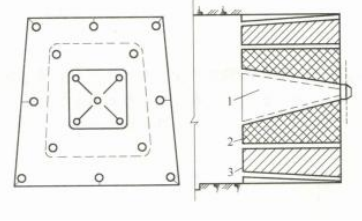
- Cut Holes: Create an initial cut cavity to provide a second free face for other blastholes. Cut holes are usually drilled 0.15–0.25 m deeper than the other holes.
- Auxiliary Holes: Enlarge and extend the break achieved by the cut holes.
- Perimeter Holes: Control the shape and dimensions of the tunnel cross-section, including roof (top) holes, floor (bottom) holes, and side-wall holes.
Cut Hole Patterns
All cut holes are aligned in one row and angled in one direction. This method is suitable for soft rock or rock with joints and fissures.
- Single-Direction Cut: All cut holes are aligned in one row and angled in one direction. This method is suitable for soft rock or rock with joints and fissures.
- Conical Cut: All cut holes are drilled toward the center of the face at equal angles without intersecting one another, forming a conical void after blasting.
- Wedge Cut: Cut holes consist of two or more rows of holes inclined symmetrically toward each other. Blasting creates a wedge-shaped cut. Wedge cuts can be subdivided into vertical wedge, horizontal wedge, and double wedge cuts.
Different cut patterns should be chosen based on the rock solidity and the tunnel cross-section, selecting appropriate hole angles and spacings.
Demolition Blasting
Demolition blasting techniques are used for the safe demolition of decommissioned buildings or structures, and are a form of controlled blasting. The core principle is to meet the demolition requirements while protecting nearby structures and equipment.
Technical Features
Demolition blasting must balance “demolition” and “protection.” Its main technical characteristics include:
- Carrying out blasting within the required demolition scope and achieving the desired fragmentation, to avoid damage to parts of the structure that must be preserved.
- Controlling the collapse direction and pile footprint; for example, a chimney must fall precisely in the designed direction.
- Controlling the scatter of debris and throw distance, to prevent flyrock from endangering nearby personnel and facilities.
- Controlling shock waves, blasting vibrations, and collapse vibrations, to ensure the safety of surrounding buildings and residents.
Demolition blasting requires understanding the structural characteristics, materials, and any construction modifications of the target structure, and analyzing the post-blast deformation and movement. A reasonable charging and initiation plan must then be designed. Blasting targets can be divided into two major categories: structures of significant height (e.g. buildings, chimneys, water towers) and foundation-type structures (e.g. equipment foundations, slabs, pile foundations). By material, targets may consist of reinforced concrete, brick masonry, steel structures, etc. Different materials should employ different powder factors (specific explosive consumption) and drilling layouts.
Blasting Safety and Environmental Protection
Flyrock, Blowout and Bootleg Control
In shallow-hole blasting, the main safety issues include blasting flyrock, blowout phenomena, and residual rock “bootlegs” after blasting. Preventive measures include:
- Reasonable powder factor: Control the explosive charge per unit volume based on rock properties and the number of free faces to avoid excessive charges that produce flyrock. Use a lower powder factor for dense rock, and a higher value for soft rock or in more open environments.
- Utilize free faces and spacing: Set the charge for each hole according to the number of free faces and the minimum burden, avoiding an overly large charge in any single hole.
- Hole inclination and stemming: Do not align the direction of minimum burden directly with the blasthole axis. Drill holes at a slight angle if necessary. Use a stemming length generally 1/3–2/5 of the hole depth to prevent flyrock and blowouts.
- Increased bottom charge: Let the bottom charge constitute about 60%–80% of the charge in each hole. This ensures the bottom rock is thoroughly broken, reducing the occurrence of bootleg after blasting.
Slope Control Blasting
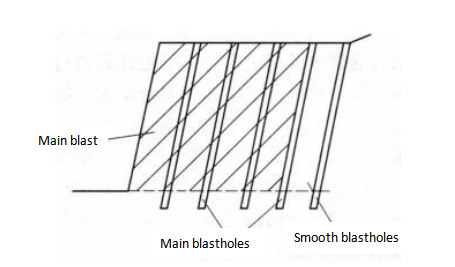
In surface excavations, to protect permanent slopes and improve slope stability, control blasting techniques such as smooth blasting and presplit blasting can be used. Smooth blasting is achieved by drilling closely spaced blastholes along the design excavation boundary and using low-power explosives, which are detonated after the main blast, to produce a smooth final rock face. Presplit blasting involves drilling a row of closely spaced holes along the excavation boundary and detonating them before the main blast, creating a continuous crack. This presplit crack reduces the impact of the main blast on the remaining rock mass that is to be preserved.
Dust Control and Environmental Protection Measures
In surface blasting, dust mainly originates from drilling and blasting, material handling, and settling of dust in the blast area, accounting for about 35%–40% of total dust emissions. The amount of dust generated increases with rock hardness; blasting water-bearing rock can reduce dust by 33%–60%. Blast-generated dust is characterized by high concentration, rapid dispersion, long suspension time, and fine particle size. To reduce dust pollution, the following technical measures can be taken:
- Drill blastholes in a uniform pattern and control the powder factor to improve the effective utilization of explosive energy.
- Use millisecond delay blasting techniques to avoid an excessive concentration of explosive energy release at any one instant.
- Select explosives matched to the rock properties to achieve wave impedance matching between the explosive and the rock.
- Implement water-filled (water-tamped) blasting by using plastic bags filled with water in place of traditional stemming; at the moment of detonation, the water bags burst and produce a water mist that captures dust.
- Spray water before blasting: install mist sprayers in the blast area and turn them on 2–3 minutes before blasting; continue spraying for 30 minutes after the blast. This can reduce dust by about half.
Summary
This article introduced the applications of blasting engineering in underground mining, tunnel excavation, and demolition projects, emphasizing the importance of blast design and parameter selection. In underground mining and tunnel blasting, blasthole layout and charge must be designed appropriately based on the working space and rock properties; in demolition blasting, both the demolition objectives and the protection of the surroundings must be considered. Key aspects of blasting safety management and environmental protection measures were discussed, including the control of flyrock, blowouts, and dust pollution. By strictly adhering to technical standards and taking appropriate protective measures, efficient and environmentally friendly blasting operations can be achieved while ensuring safety.