News Banner

INDUSTRY KNOWLEDGE

LATEST NEWS

The Fundamentals of Industrial Detonators: Principles, Classification, and Technological Development
Date 2026-10-20

The Fundamentals of Industrial Detonators: Principles, Classification, and Technological Development

I. Definition and Engineering Significance of Industrial Detonators Industrial detonators are critical initiation devices used to initiate industrial explosives, detonating cords, and shock tubes. They are widely applied in engineering fields such as transportation infrastructure, mining, coal, petroleum, metallurgy, chemical industry, water conservancy, electric power, and urban construction. They are among the most core, most […]
Interpretation of Key Engineering Geological Elements in Mine Blasting
Date 2026-10-12

Interpretation of Key Engineering Geological Elements in Mine Blasting

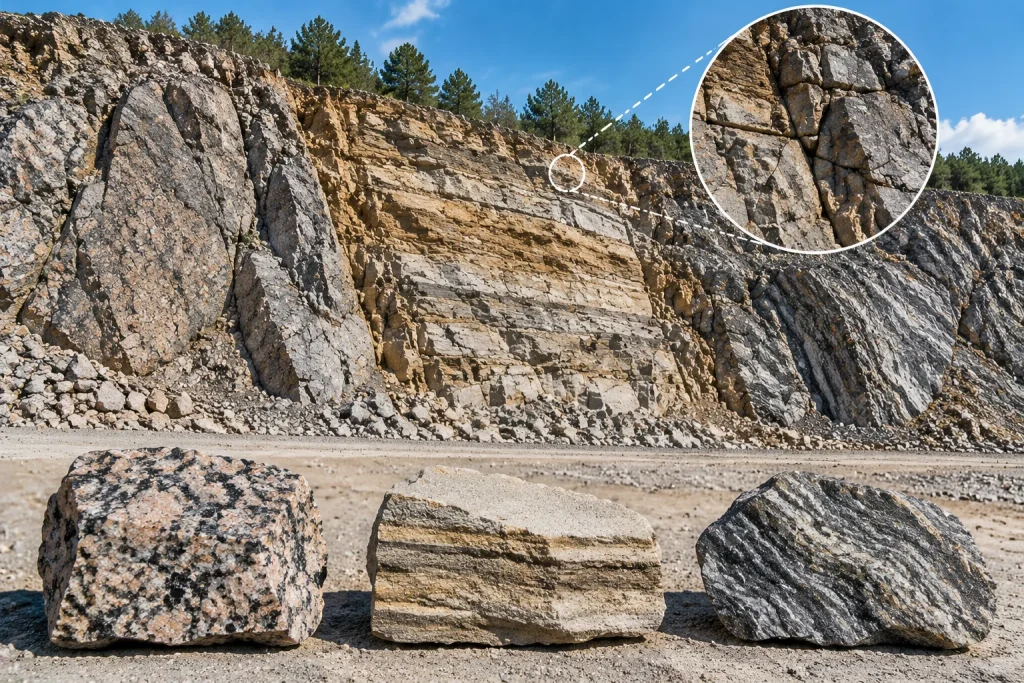
Successful mine blasting design and construction are founded on a thorough understanding of the engineering geological conditions, especially the rock types, physical-mechanical properties, and dynamic characteristics. Since the primary target of earthwork blasting is rock, only by fully understanding the rock’s hardness, blastability, and response under explosive impact can one correctly select blasting parameters, determine […]
Research on Industrial Explosives Detonation Performance Testing Standards and Quality Management Systems
Date 2026-09-23

Research on Industrial Explosives Detonation Performance Testing Standards and Quality Management Systems

I. Theoretical Basis of Industrial Explosives Detonation Performance Testing 1. Relationship Between Detonation Performance and Blasting Efficiency The detonation performance of industrial explosives determines their effectiveness in practical blasting operations. The energy released during an explosion manifests through several mechanisms such as rock fragmentation, medium compression and deformation, and shock wave propagation. The proportion of these energy […]
In-Depth Interpretation of Blasting Engineering: Geology, Initiation Networks, and Special Environments
Date 2026-09-18

In-Depth Interpretation of Blasting Engineering: Geology, Initiation Networks, and Special Environments

In-Depth Interpretation of Blasting Engineering: Geology, Initiation Networks, and Special Environments Blasting engineering integrates geological investigation with engineering technology. To achieve safe and efficient blasting operations, it is essential to understand rock mass structures, scientifically configure initiation networks, and master technical measures for special environments. This article provides a detailed interpretation from multiple perspectives. Geological […]
Industrial Blasting Materials: Advanced Technical Guide – Principles, Processes, and Engineering Applications
Date 2026-09-14

Industrial Blasting Materials: Advanced Technical Guide – Principles, Processes, and Engineering Applications

I. Detonation Reaction Kinetics and Oxygen Balance Theory Explosive detonation is essentially a rapid chemical reaction, distinct from conventional combustion in three major aspects: • Strong exothermic reaction (source of energy) • Extremely high reaction rate (formation of shock waves) • Generation of large volumes of gas (working medium for energy transfer) 1. The Key […]
Why Rock and Geological Conditions Must Be Studied First in Civil Blasting
Date 2026-08-01

Why Rock and Geological Conditions Must Be Studied First in Civil Blasting

In civil blasting engineering, rock is the primary blasting target. To achieve good blasting results, it is not enough to focus only on charge quantity and initiation methods; it is essential to first understand the rock type, rock strength, integrity of the rock mass, and on-site geological structures. The hardness of the rock and the integrity […]
Blasting Engineering Applications and Safety: Underground Mining, Tunneling, and Demolition
Date 2025-11-14

Blasting Engineering Applications and Safety: Underground Mining, Tunneling, and Demolition

Underground Mining Blasting Compared to surface blasting, underground mining blasting is characterised by confined working spaces, smaller scales but more frequent blasts, and greater influence from geological conditions. Compared to underground roadway blasting, underground mining blasting typically involves more than two free faces, a larger number of blastholes, and more complex blast designs and initiation sequences, which makes the […]