
Blasting Engineering Guide: Geology, Networks & Special Environments
 2025-12-05
Blasting engineering integrates geological investigation with engineering technology. To achieve safe and efficient blasting operations, it is essential to understand rock mass structures, scientifically configure initiation networks, and master technical measures for special environments. This article provides a detailed interpretation from multiple perspectives.
Geological Structures and Blasting Design
The internal structures of a rock mass—such as bedding, joints, folds, and faults—determine its stability and blasting performance.
Primary structural planes include bedding or foliation formed during sedimentation or intrusion,
Whereas structural planes such as folds, joints, and faults are weak surfaces formed by tectonic movements. Secondary planes include cleavage and joint sets developed under external stresses.
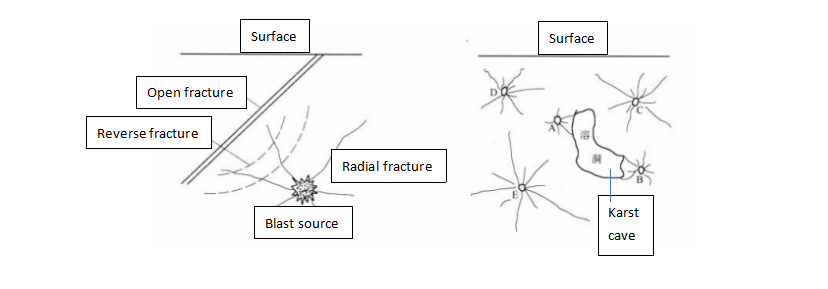
These structures may appear as anticlines or synclines. When blast holes are close to weak zones, explosive energy may reflect, concentrate, or dissipate, forming radial cracks that increase vibration or shift the designed break line. Therefore during design, hole spacing and charge quantities must be adjusted according to the orientation and spacing of joints, avoiding weak planes. The drilling pattern should reflect the rock mass thickness and the number of free faces to minimize flyrock and hole collapse.
Initiation Network Configuration and Construction
Initiation networks use wires or detonating cords to connect blast holes into circuits that fire in a predetermined sequence.
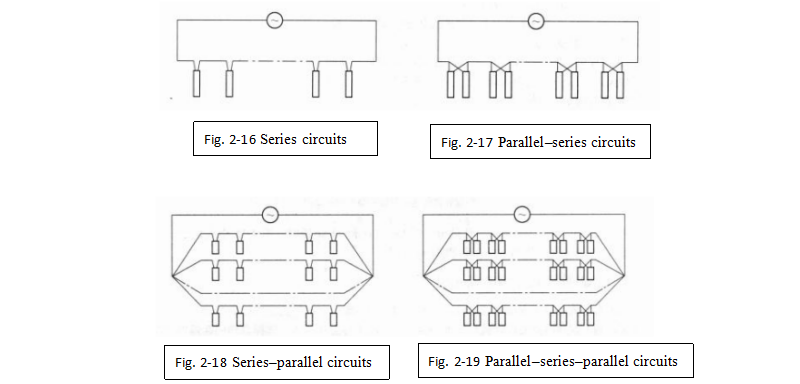
Common electric initiation circuits include:
• Series circuits
They are simple to operate and easy to inspect, requiring low power output. They are particularly suitable for capacitor-type logger.
• Parallel–series circuits (hybrid networks)
They are predominantly use non-electric shock tube systems with a simple electric circuit firing the shock tube network. This is the most common configuration in hybrid initiation systems and is compatible with capacitor loggers or industrial-frequency AC power.
• Series–parallel circuits
They are suitable for low-voltage, high-power industrial-frequency AC power and widely used in underground deep-hole blasting.
• Parallel–series–parallel circuits
They are also applicable to low-voltage, high-power industrial-frequency AC initiation.
Network design requires balanced resistance in each branch, with each branch carrying a current greater than 2.5 A.
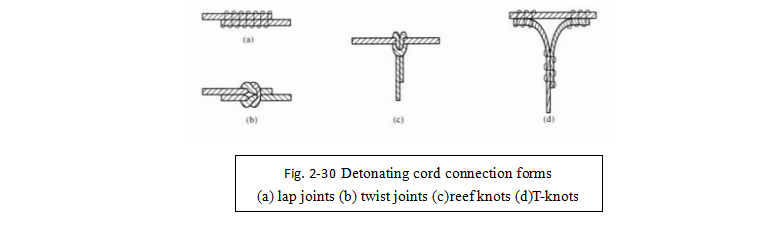
During construction, detonators and lead wires must be uniformly sourced from the same manufacturer and the same production batch to ensure consistent resistance. Connections must be made after charging, and all wires must be intact and insulated. In areas near high-voltage lines or electromagnetic interference, anti-interference detonators and shielding measures should be adopted. Detonating cord connections may use forms including lap joints, twist joints, reef knots, or T-knots, whereby joints should remain straight and be kept at a safe distance from the hole collar to ensure reliable detonation transfer.
Advantages of Electronic Detonators
Electronic detonators contain built-in chips that allow programmable delay times ranging from 0–20,000 ms. Through RF communication, each detonator can be assigned an identification number and programmed. The system can detect circuit integrity and detonator status before firing, providing warnings for miswires or faulty detonators to prevent misfires. Safety features include password protection, electromagnetic shielding, and anti-tamper functions. These reduce operational errors, significantly lower vibration and noise, and are ideal for urban blasting, tunnel construction, and large-scale delayed blasting operations with strict technical requirements.
Shallow Bench Blasting and Frozen Ground Blasting
Shallow bench blasting typically involves benches less than 5 m deep with borehole diameters under 50 mm. Short burden distances can easily cause flyrock and airblast. During design, it is essential to control hole spacing, charge quantities, and properly arrange sufficient free faces and moderately increase bottom charge and stemming to help maintain confinement. For weak rock layers, inclined holes or staged firing can reduce overbreak and minimize bootlegs.
Frozen ground can be classified into short-term, seasonal, and permafrost layers. Low temperatures increase soil strength, so watergel or emulsion explosives with good frost resistance should be used. The choice between pre-freeze or post-freeze charging depends on environmental temperature. Construction often combines loosening blasting with staged initiation. Borehole diameters typically range from 80–100 mm, with specific charge consumption around 0.25–0.655 kg/m³per unit, and minimum burden controlled at 1.5–3 m. The proper selection of drilling tools and charging methods ensures effective fragmentation while protecting surrounding facilities and equipment.
Frequently Asked Questions
Q: How do geological structures affect blasting?
A: Weak zones in rocks can cause explosive energy to reflect, concentrate, or dissipate, increasing vibration or shifting the break line. Hole spacing and charge quantities must be adjusted according to the orientation of structural planes.
Q: Why must detonators come from the same batch?
A: Detonators from different batches may vary in resistance and firing current. Mixing them can cause inconsistent delays or misfires. Using the uniformed batch ensures reliable and synchronous initiation.
Q: What advantages do electronic detonators offer?
A: They provide programmable precise delays, circuit diagnostics, password protection, and location identification. They significantly reduce vibration and noise, making them suitable for high-precision blasting.
Q: How can shallow-hole blasting reduce flyrock?
A: Control hole spacing and charge amount, increase free faces, extend stemming lengths, and adopt inclined holes or staged initiation.
Q: How should explosives be selected for frozen ground?
A: Frozen ground has higher strength, so frost-resistant watergel or emulsion explosives should be used. Depending on the temperature, the charging operation is carried out either before or after freezing.