
Testing Theory and Safety Factors in Industrial Explosives
 2025-11-28
Work Capacity
Work capacity refers to the total useful work produced by an explosion and is a key indicator for evaluating blasting effectiveness. The work generated by an explosion manifests in multiple forms, such as medium fragmentation, medium compression, and shockwaves in air. To maximise the useful portion of explosive energy, charging structures must be properly designed to opimise the useful work of an explosion.
Common test methods for work capacity include the lead cast expansion test method, underwater explosion test, ballistic mortar test method, ballistic pendulum method, and ejection crater method.
Among these, the lead cast expansion test method is widely used because it does not require specialised equipment. In this method, a specially lead cast is fitted with an explosive charge. After detonation, the expansion volume of the cavity is measured to evaluate the explosive’s work capacity. The lead cast must be made of high-purity lead and calibrated using standard TNT. Additionally, the explosive sample must be pressed into cartridges of specified density before testing. After initiation, the cavity expansion is measured by water displacement, and parallel tests must be conducted for accuracy on each sample. A limitation of this method is that expansion volume is not a direct unit of work, meaning values cannot be directly compared across different explosive types.
Sympathetic Detonation Distance
Sympathetic detonation refers to the phenomenon where a detonating charge causes nearby cartridges to detonate due to transmitted shock waves. The sympathetic detonation distance is the maximum spacing at which unintentional detonation will certainly occur, whereas the safety sympathetic detonation distance is the minimum spacing at which sympathetic detonation will absolutely not occur. The research of this phenomenon ensures reliable blast transmission between cartridges, and provides safety spacing data for plant design.
Industrial explosives typically follow the testing method for sympathetic detonation distance prescribed in WJ/T 9055-2006. The donor and acceptor cartridges are manufactured to specified diameters and masses. The acceptor cartridge is positioned in a semicircular groove formed in compacted sand, while the donor cartridge—initiated with a standard detonator—is placed nearby so that the energy will be transmitted through air.
Multiple trials are conducted to determine the maximum sympathetic detonation distance at which sympathetic detonation occurs three consecutive times, or to verify compliance by determining whether detonation occurs at a prescribed distance. Bulk explosives must first be pressed into cartridges of specified dimensions before testing. Water-resistant explosives require immersion treatment before testing, and emulsion explosives must be pressed with a wooden rod and cut flat as required by standards.
Brisance (Detonation Shattering Power)
Brisance describes an explosive’s ability to shatter the medium in direct contact and is an important indicator of rock-breaking efficiency.
In China, it is common to use the lead compression test method, also known as the Geste Method, to evaluate the brisance of explosives. A pure-lead column is firstly placed on a thick steel plate, with the explosive sample placed in a paper tube on top of the column, and then the charge is initiated with a detonator. After detonation, the lead column expands into a mushroom shape. The reduction in its height of the compression value indicates brisance—the greater the compression, the higher the brisance. Lead columns must be cast under strict conditions at prescribed temperatures in a single pour and calibrated with standard TNT.
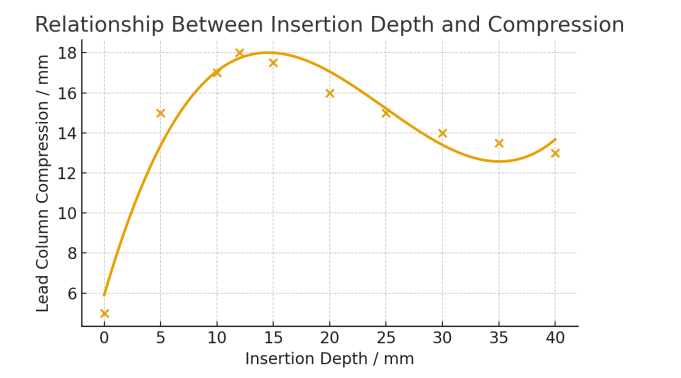
Although it is simple and widely used for quality control, the lead compression test method has limitations: the compression is not proportional to the deformation work, the results are strongly influenced by the explosive’s detonation ability and critical diameter, and the method is applicable only to low-density, low-brisance explosives. High-density explosives require thicker steel plates or reduced the amount of charge, making results difficult to compare across conditions. For this reason, the International Standards Committee recommends the copper column compression test for industrial explosives to evaluate the brisance of industrial explosives.
Detonation Velocity (VoD)
Detonation velocity is the speed at which the detonation wave travels through the explosive, and it reflects the reaction rate of the explosive. The detonation wave is an intense shock wave driven by the explosive’s chemical reaction.
VoD is influenced by several factors:
First, charger diameter influences VoD. When the charge diameter is too small, it allows the expansion wave penetrate the reaction zone, which reduces VoD. The stable detonation requires a diameter greater than the critical diameter. Second, the density of explosives also impact VoD. For single-component explosives, VoD generally increases with density. For bulk explosives, excessively high density may reduce VoD. At last, Finer inert particles absorb more energy, resulting in lower VoD.
Common VoD measurement methods include the detonating cord comparison method and electronic timing method. The detonating cord method determines the detonation velocity by comparing the spacing of the marks left on an aluminum plate by the test explosive with those made by a detonating cord of known velocity. In the electronic timing method, sensors record the time difference as the detonation wave passes two points.The VoD is yielded by dividing the distance by the time difference. According to GB standards, it is required to test and clearly report conditions of sample diameter, density, initiation method .
| Name of Explosives | density/ g/㎝3 | VoD/ m/s |
| TNT | 1.60 | 7000 |
| Tetryl | 1.60 | 7319 |
| RDX (Cyclonite) | 1.60 | 8200 |
| PETN (Pentaerythritol Tetranitrate) | 1.60 | 8281 |
| Porous Granular ANFO Explosives | 0.90~0.93 | 2500~3300 |
| Expanded Ammonium Nitrate Explosives for Rock Blasting | 0.88~0.92 | 3200~3800 |
| Powdery Emulsion Explosives for Rock Blasting | 0.88~0.91 | 4000~4400 |
| No. 2 Ammonium Stibnite Explosive for Rock Blasting | 0.95~1.10 | 3300~3700 |
| No. 2 Coal Mine Permitted Ammonium Stibnite Explosive | 0.95~1.10 | 3000~3400 |
| No. 3 Coal Mine Permitted Ammonium Stibnite Explosive | 0.95~1.10 | 2800~3300 |
| No. 1 ANFO Explosives | 0.9~1.0 | 3300~3600 |
| No. 1 Ammonium Sawdust-Wax Explosive | 0.9~1.0 | 3300~3700 |
| No. 4 Powdery Ammonium Stibnite Explosives for Rock | 0.95~1.10 | 3500~3800 |
| No. 1 Nitroglycerin Gelatin Explosive | 1.4 | 6230 |
| No. 2 Emulsion Explosive for Rock Blasting | 1.05~1.20 | 4500~5600 |
| Class II Coal Mines Permitted Emulsion Explosive | 1.05~1.20 | 4000~4700 |
| Class III Coal Mines Permitted Emulsion Explosive | 1.05~1.20 | 3300~4200 |
| NoteFor neat TNT and other pure explosives, the density listed in the table refers to the explosive density.For industrial explosives (except porous granular ANFO), the density refers to the cartridge density. | ||
The form shows the range of VoD of several typical explosives. For example, the VoD of TNT , RDX and emulsion explosives for rock blasting are respectively around 7000 m/s, 8200 m/s and 4000–4400 m/s in the standard density. These data illustrate how detonation performance is impacted by different formulation and density.
Toxic Gas Content After Detonation
Explosive detonation generates complex gases, among which carbon monoxide (CO) and nitrogen oxides (NOx) are toxic. In China, GB 18098 is currently used to measure post-blast toxic gases. A fixed quantity of explosive is detonated in a chamber of known volume, and the total gas volume along with CO and NOx concentrations are measured. Results are converted into total toxic gas output. Negative oxygen balance tends to increase CO production, whereas positive oxygen balance increases NOx. NO₂ is converted to its CO-equivalent toxicity for evaluation.
Density and Moisture Measurement
Explosives’ density and moisture content directly affect detonation performance and are therefore basic quality-control parameters.
Industrial explosives are divided into cartridge density and explosive density. Cartridge density refers to the total density including packaging, whereas explosive density is the true density excluding packaging.
Common methods to measure cartridge density include direct measurement and volumetric methods. The former determines the density by weighing the cartridge and measuring its geometric dimensions, while the latter places the cartridge in water and calculates the density based on the increase in water volume. The determination of explosive density can be performed by direct measurement, graduated cylinder method, pycnometer method, or weighing method, all of which are generally based on measuring mass and volume to calculate the density. Moisture content is mainly determined using the vacuum oven method or a moisture analyser, where the sample mass change is measured through drying or constant-boiling distillation to obtain the water content.
Compatibility and Safety
Compatibility refers to the ability of an explosive’s componentsand the materials it contactsto remain chemically stable. It includes internal compatibility (between components) and external compatibility (between explosives and packaging materials). Low compatibility may reduce stability and detonation point, alter mechanical or initiation sensitivity, or even corrode packaging materials. Assessment methods include vacuum stability testing, differential thermal analysis (DTA), differential scanning calorimetry (DSC), thermogravimetric analysis (TGA), gas chromatography, and metal corrosion tests.
Conclusion
The safe use of industrial explosives relies on comprehensive evaluation of their physical, chemical, and detonation characteristics. The indicators presented—work capacity, sympathetic detonation distance, brisance, detonation velocity, and toxic gas output—each have rigorous standardised testing methods and evaluation criteria. These tests help manufacturers ensure product quality while providing essential data for blast design and safety management. As new explosive formulations emerge and manufacturing technologies advance, testing methods and standards are continuously evolving as well. A scientific and reliable indicator system remains fundamental to ensuring engineering safety and improving operational efficiency.