
Why Rock and Geological Conditions Must Be Studied First in Civil Blasting
 2026-08-01
In civil blasting engineering, rock is the primary blasting target. To achieve good blasting results, it is not enough to focus only on charge quantity and initiation methods; it is essential to first understand the rock type, rock strength, integrity of the rock mass, and on-site geological structures. The hardness of the rock and the integrity of the rock mass determine the basic quality of the rock mass, while structural features such as bedding, faults, joints, and fractures not only directly affect blasting performance but also influence blasting safety and the stability of post-blast slopes, surrounding rock, and bedrock.
From an engineering perspective, rock and rock mass are not the same concept. Rock is the fundamental material composing the Earth’s crust, whereas a rock mass is an assemblage of rock blocks segmented by various weak planes under natural conditions. In many cases, the strength of a rock mass is lower than that of the intact rock itself. Therefore, civil blasting design must consider both rock properties and rock mass structural characteristics.
Rock Classification Determines the Basic Judgment of Blasting Design
By origin, rocks are mainly divided into igneous, sedimentary, and metamorphic rocks. Igneous rocks are formed by the cooling or eruption of magma, with common types including granite, diorite, diabase, and basalt. Sedimentary rocks are formed through weathering, transportation, deposition, and consolidation, with common examples such as limestone, sandstone, shale, and conglomerate. Metamorphic rocks are formed when existing rocks are altered under high temperatures and pressures, including marble, slate, quartzite, and phyllite.
Rocks of different origins vary in mineral composition, texture, structure, and integrity, leading to different blasting responses. Generally, igneous rocks have stronger resistance to blasting and relatively poorer blastability, while sedimentary and metamorphic rocks are relatively easier to blast.
What Rock Properties Affect Civil Blasting Performance
The rock properties most closely related to blasting mainly include density, bulk density, porosity, wave impedance, degree of weathering, and frost resistance. Generally, higher density and bulk density indicate greater rock strength and resistance to blasting, requiring more energy for fragmentation and displacement. Increased porosity reduces the propagation velocity of shock waves and stress waves in the rock.
Wave impedance is particularly important. The efficiency of energy transfer from explosives to rock after detonation is closely related to the impedance matching between the explosive and the rock. The closer the match, the better the blasting performance.
In terms of mechanical properties, rocks exhibit elasticity, plasticity, and brittleness, with hard rocks typically showing dominant brittle behavior. Rocks generally have high compressive strength but much lower tensile and shear strength. Therefore, under blasting, cracks tend to initiate and propagate along weak zones. A better understanding of these properties provides a stronger basis for determining specific charge consumption, blasthole pattern parameters, and charge configuration.
Key Effects of Structural Planes on Blasting Performance
In practice, the success of blasting is often determined not only by rock hardness but more importantly by whether structural planes such as bedding, joints, fractures, and faults are present in the rock mass. Their influence on blasting is mainly reflected in six aspects: stress concentration, enhanced stress wave reflection, energy absorption, energy dissipation, wedging effects, and alteration of fracture lines.
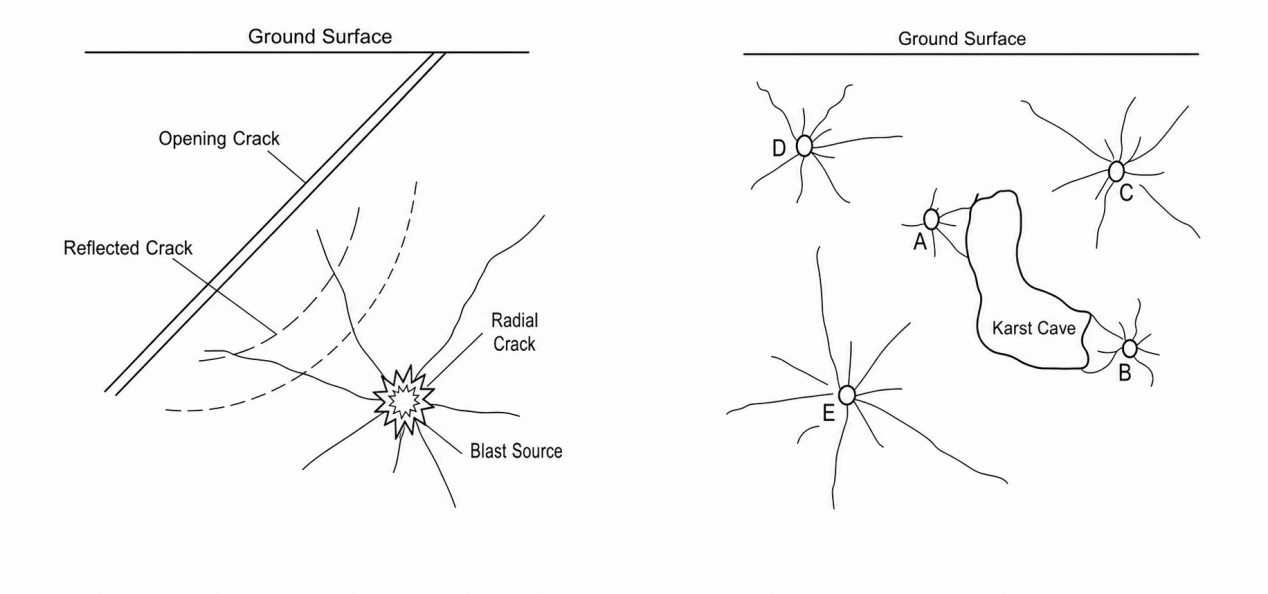
When weak planes are present, cracks tend to initiate along these zones first. Therefore, in areas with well-developed weak planes, the specific charge can often be reduced appropriately. When weak zones intersect the blast source and extend to a free surface, explosive energy may escape, significantly reducing blasting effectiveness. Additionally, when large structural planes are located at different positions relative to the charge, they can alter the shape of the blasting crater, blasting volume, and throw direction.
Balancing Blasting Performance and Slope Stability
Civil blasting must consider not only blasting effectiveness but also the impact on retained rock mass and slope stability. Blasting can cause varying degrees of damage to the rear ground surface, deep bedrock, and the internal rock mass of slopes. To reduce back-break cracks and slope damage, presplit holes can be drilled behind the final row or behind the final fracture line. Presplit blasting is then conducted before the main blast. This approach can significantly reduce or even prevent backbreak cracks and produce smoother, more stable slopes.
To protect deep bedrock, installing a flexible cushion layer at the bottom of blast holes is also an important measure. Due to its compressibility and its ability to attenuate shock waves, the cushion can reduce damage to the rock below the hole bottom and also lower blasting vibration velocity to some extent.
Frequently Asked Questions (FQA)
1. Why must geological investigation be conducted before civil blasting?
Because rock properties, rock mass integrity, and geological structures directly affect blasting parameters, blasting effectiveness, safety, and post-blast slope stability.
2. Which types of rocks are usually harder to blast?
Generally, igneous rocks have stronger resistance to blasting and poorer blastability, while sedimentary and metamorphic rocks are relatively easier to blast.
3. What direct impacts do structural planes have on blasting?
Structural planes can cause stress concentration, energy absorption, energy dissipation, and changes in fracture lines, thereby affecting charge consumption, blasting volume, fragmentation, and throw direction.
4. Why are geological structures more important in deep-hole blasting?
Because well-developed structural planes may cause rock mass displacement, charge column interruption, localized misfires, and blasthole deviation, significantly affecting construction quality.
5. How can blasting damage to slopes and bedrock be reduced?
Measures such as presplit blasting, smooth blasting, and flexible cushion layers at the hole bottom can be used to reduce backbreak cracks, internal damage, and vibration effects.